
Unit 1. EQUIPMENT FOR YOUR SAND THERAPY JOURNEYS
To start on your first Sand Therapy Journey, you will need the following:
- A sandtray
- Sand
- A selection of small objects, figures, miniatures, toys etc that can be used as symbols in your sandtray
- A basket (optional)
Please note I am only familiar with supplies available in the UK, so am making recommendations below on the basis of that knowledge – if you live elsewhere in the world, I suggest you contact those colleagues locally who are already using sand in their practice for advice on obtaining a sandray etc.
1.1. CHOOSING A SANDTRAY
Standard sandtrays used both in classic Jungian and Integrative Sandplay Therapy tend to have particular specifications. For the purposes of the work we will do during our Sand Therapy Journeys it will be helpful though not absolutely essential to have a standard wooden sandtray.
If you or perhaps your partner/friend etc have woodwork skills and motivation to make your own tray, the recommended dimensions are 72 x 49.5 x 7.5 cm (approximately 31″ x 20″ x 3″). A smaller sandtray is acceptable if you are working in a small space, though I would suggest it should have as much room as possible for your setting. It is important that the sandtray is rectangular, rather than square or round (smaller round, square or hexagonal trays can be used in addition to your main sandtray but ideally not instead of it).
*Beautiful Container for Our Psyche*
My Integrative Sandplay teacher John Daly was very keen for the sandtrays to be made as neatly and beautifully as possible – after all, when used in therapy work, it becomes a container for our soul – and our souls deserve the best, don’t they? John insisted that there should be no knots or hardly any knots in the wood, and that the joints should be very neat and concealed, whenever possible. The edges of the tray should ideally be nicely bevelled. I am very fortunate in that my partner makes very beautiful wooden trays, so I have several at my Sand & Sound Centre.
However, many other types of tray are perfectly suitable, especially when you are beginning your journey in the sand.
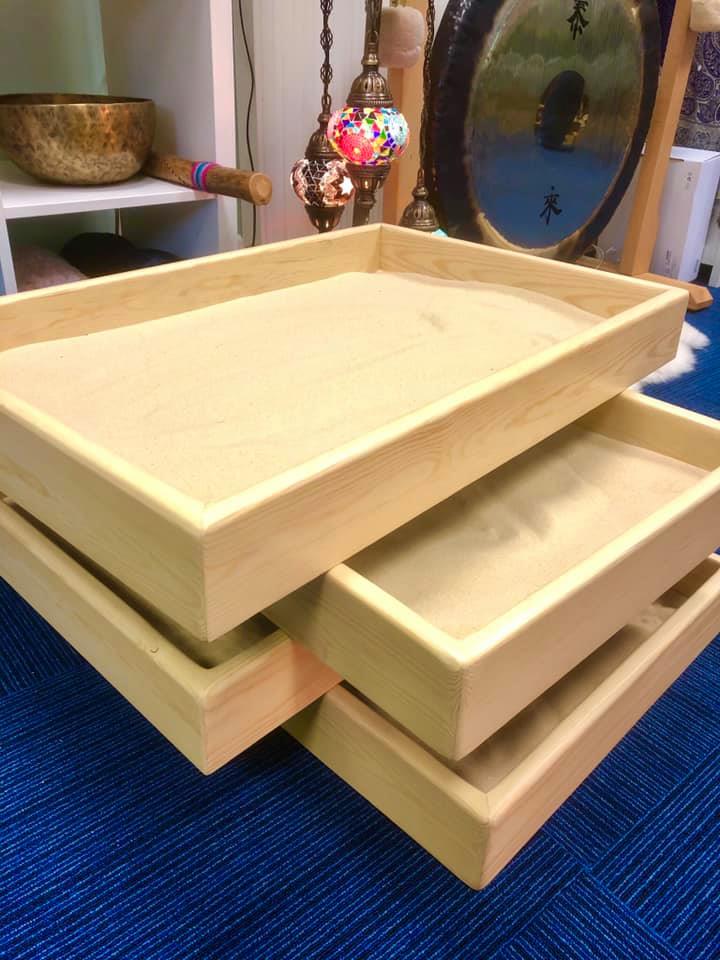
*Wooden Trays*
Custom-made wooden sandtrays can be expensive but a good investment especially if you may use this in your work in the future.
Apart from my partner Andrew’s wonderful sandtrays (which are not available for sale at the moment – though it may change in the future!) – a very reputable supplier in the UK is Artisand Trays https://www.artisandtrays.co.uk/
*Plastic Trays*
Rectangular plastic trays, especially blue ones, can be suitable, if you are not able to obtain a wooden one.
In the UK, Lakeland have a generous-sized blue tray designed for soaking oven racks – this is a little smaller and and bit deeper than a standard wooden sandtray but a great alternative if you are on a budget https://www.lakeland.co.uk/20228/oven-rack-soaking-tray
Shallow boxes of “Really Useful Box” brand can also be used – the 10 litre version is smaller than a standard tray but quite acceptable as a started tray. These boxes are are very practical as they have handles for carrying and useful lids. Ideally, I would paint the bottom blue if using one of these boxes.
If you don’t have access to any of the options above, any rectangular box that is not too deep (ideally in blue) can be used – I had a plastic cat litter tray for the first four years of my sand explorations before I bought my first wooden tray! (and it was green 🙂 )
*Blue Bottom and Sides*
Most sandtrays used for therapy have either a blue bottom (to represent water), or blue bottom plus blue inner sides (to represent water and sky)
I personally prefer to have the sides of the tray to be plain, and I have heard some people mention that they find a tray with blue sides a little overwhelming, but it is your choice how you would like your tray to be.
If your tray does not have a blue bottom in its original state, you could choose to paint it. I particularly like the shade of paint from Wickes DIY store called ‘Sail Away’ (a small tester pot should be enough) – but other shades of blue are fine, though I would suggest to avoid dark blues.
The paint can be protected using a couple of coats of clear varnish.
*Waterproofing*
Jungian sandplay therapists and many other sand therapy professionals use two sandtrays, one for dry and one for wet sand. However, if you are not sure whether you will want to continue your sand explorations, or don’t have a lot of space, one tray will be adequate. If you intend to use water in your wooden sandtray it will need to be waterproofed with some form of sealant/good quality varnish – ideally yacht varnish.

*Round & Hexagonal Trays*
If you have space for an additional tray you may choose to have a round and/or hexagonal sandtray as well (if you only have space for one, best to opt for a rectangular one). Artisand Sandtrays whom I recommended above make nice round and hexagonal wooden trays.
Very occasionally you may be able to find a large round, flat-bottomed, wooden bowl intended for fruit or salad, that could be suitable – I have a couple that are nearly 40cm (16″) across, one of them is from Homesense department of TKMaxx.
The experience of using a round, hexagonal – or a square – container is quite different from that using a rectangular one, and I suggest that you use it as an extra tray (if you can afford the space and money) and not instead of a standard rectangular one. Size-wise, aim for one as large as possible but small enough to fit within your main sandtray.

1.2. SAND FOR YOUR SANDTRAY
Now it is time to put some sand in your sandtray! For this, you will need a bag of ordinary Play Sand, the sort that is sold for sandpits. Clean beach sand is suitable too – if it is legal to collect it in your area – please make sure that you don’t remove any small animals from the shore if you are collecting your sand in nature.
Shop-bought play sand can vary in quality and colour depending on the supplier, I particularly liked the brand called ‘Carousel’ which used to be sold in the UK by Tesco supermarket until 3-4 years ago, as it was quite fine and pale in colour – but unfortunately I cannot find it any longer.
In the UK you can buy play sand from supermarkets, Argos, DIY shops, garden centres, and online. A typical size of bag is 10 kg and that tends to be just right to fill a standard sandtray.
If you like very fine, almost white sand, there is a brand called Komodo Natural Sand which is used by reptile-keepers for vivariums – it is very soft and many of my students and clients really enjoy it – however it is more expensive than normal play sand and is sold in smaller bags (5 kg), so you will likely need two bags to fill a standard sandtray. Another advantage of Komodo sand is that it is packaged already dry.
Even “new” sand may have some debris in it – if there seems to be a lot of bits, you may want to sieve the sand and remove any rubbish, but a few pieces of debris are not a problem.
*Drying your sand*
Unless the sand is labelled as ‘kiln-dry’, it will normally be supplied damp in a plastic bag. If that is the case, you may want to dry the sand before you use it. At room temperature a few centimetres layer of sand in a sandtray can take as long as 1 to 2 weeks to dry. Alternatively, if you want to dry it quickly it can be done in the oven, pouring the sand in thin-ish layers on baking trays. This is also a good way to sterilise your sand, should you wish to do so. This method is likely to result in sand getting everywhere in your kitchen, though, and your roasts may be a little crunchy for a while afterwards! 🙂 Some people may feel that they “cook away” the sand’s special energy, but I have not found this to be the case – for me “cooked” sand works just as well as “naturally dried” sand.
*How much sand?*
In terms of the amount of sand you will need, that depends on the size and depth of your tray. I find that between 3 and 5 cm depth seems to work well – but if you have a smaller than standard tray, do the following test. When you create a “lake”, “river” or “seashore” in your sandtray by exposing the blue bottom of the tray, if the sand is falling in too much, obliterating your body of water, it means there is probably too much sand in the tray. Remove some until you are able to create a “lake” or a “river” without too much difficulty.
*Symbolism of Sand*
You can read about some of the special qualities of ordinary quartz sand in the following article – Meet a Sandplay Symbol: SAND
You can also listen to my Sand Meditation exploring some of these qualities.
*Alternative sand options*
A few words about the so-called kinetic sand. Whilst many children and therapists enjoy using this (and my own grandchildren love it!), and you can buy kinetic sand in different colours, I don’t find it suitable for Integrative Sandplay or classic Jungian Sandplay, and do not recommend it for your Sand Therapy Journeys, should you decide to travel with me into the magical world of sand. Kintetic sand is created by combining ordinary sand with silicone oil, which makes it mouldable and very enjoyable as a sensory toy for many.
However, its qualities are different from those of ordinary sand, and also, whilst these cases are rare, there have been reports of dangerous bowel obstruction caused by ingestion of kinetic sand by chidren and pets.
There are other options of play sand of different colours which you may like (e.g. such as the bags of sand in pastel pink, green and blue, often sold by Aldi in summer), but I suggest to use this in a separate small sandtray, in addition, and not instead of, normal play sand.
You can see examples of different types of sand in the video below.
1.3. SYMBOLS FOR YOUR SANDTRAY
The sand itself carries potent symbolism of Mother Earth, the Four Elements, time, timelessness, infinity, cleansing and healing. Sometimes you may want to simply connect with the sand and that is enough. Most people working with sand therapy, however, will want to use a selection of symbols.
*Creating your sand symbol collection*
You can read my article on which symbols to include in your collection, where to find them, and how to build and store your collection.
You can also find information about Natural Found Objects you can use in the sandtray in this article.
*Free symbols to start your collection*
Symbols for your sand collection do not have to be expensive or difficult to obtain. If you look around your home, you are likely to find quite a few objects to start your collection (unless your home is very tidy and free from clutter), for example:
- unwanted or broken ornaments
- old watches
- broken jewellery
- toys which children have outgrown
- cards, stationery
- pieces of string or ribbon
- candleholders and candles/tealights
- crystals
- buttons
- old Christmas decorations
- small house plants
- craft materials
- small pieces of fabric
- Scrabble tiles
- clothes pegs
- small mirrors
- broken china
- strips of tinfoil
- fridge magnets.
*Learning about symbolism*
If you are interested in learning about different symbols and their meanings, there is a vast amount of information on the internet, and there are many symbol dictionaries available – none of them comprehensive, as it is impossible to collate ALL of the information on any particular object, animal, being, etc – some will always remain beyond our conscious knowledge.
Some of the symbol dictionaries I use myself from time-to-time:
– Chetwynd, T. (1998). Dictionary of Symbols (Language of the unconscious). Thorsons.
– Gheerbrant, A., Chevalier, J., et al (1996). The Penguin Dictionary of Symbols. Penguin
– Hall, J. (2007). Dictionary of Subjects and Symbols in Art. Westview Press
– Tresidder, J. (2004). The Complete Dictionary of Symbols: In Myth, Art and Literature. Duncan Baird.
This is by no means an exhaustive list. Be mindful that the personal meaning of symbols can me much more important than any universal/archetypal meaning you may gleam from dictionaries and encyclopaedias, so hold this information lightly.
We will be learning a lot more about the symbolism in the full 6-month Sand Therapy Journey programme.
*Making your own sand symbols*
If you would like to have a go at making some of your own symbols you can watch the video below where I show you a few of the ones I have created myself.
1.4 BASKETS
You don’t have to have a special basket for your Sand Therapy Journeys, but it is really nice to have one. A basket is used to collect your symbols and carry them to your sandtray. Some people will just pick and carry individual symbols one by one, others may use a plastic container (such as a lid from a storage box). For me, a nicely made round or oval basket provides and additional safe holding space for our symbols as they are travelling to their destination.
For me, the best baskets are sturdy, have handles that do not easily become detached and have solid sides (so that there is no risk of things falling through).
Thank you, I will clearly need another journal to track my journey and book on symbols…I have just remembered from this i have a collection of old watches somewhere in my cluttered home! Getting excited for the journey.
Welcome Tracy, so lovely to have you come on this journey with me! There will be a journal template offered within the 6-month programme which you can print, or just copy into your existing journal 🙂
Fabulous. Thank you. Really excited to start this journey in the sand.
I’m drying out some fresh new sand for the journey. It’s been 3 weeks and it’s still a bit damp!!
Looking forward to this magical mystery tour to my inner self. I wonder what I will find. 🙏🏻
Thank you 🙏🏻
You could dry it in the oven but it can get messy! 🙂
A big thank you for such an amazing offering. I can’t wait to go into the next unit.
I have learned so much in this one unit and it feels magical to explore.
I offer sand with the children who join my PC counselling sessions and I have watched them grounding themselves in the sand as soon as they join me.
I have been wanting to join a sand therapy group for some time and am hopeful that I can join your 6-month programme (although aware that I may be too late).
I look forward to exploring unit 2 tomorrow
Hi Lorraine, thank you for your lovely feedback, I am delighted that you have enjoyed Unit 1 of the Introduction to Sand Therapy Journeys 🙂 Hope you will find Units 2 and 3 useful too!
You are not too late to join the 6-month programme – registration for that will be open between 3rd and 10th October, and we will be starting on the 10th. Will be great to have your on this adventure! 🙂
Really like the symbols you have made. It’s great to see people making things for this modality. Home made symbols carry lots of meanings and are such a gift to any collection
Thank you, Alison! Yes hand-made symbols are such a great addition to Sand Therapy collection.. it does make it a little harder when things are broken though, I often get quite attached to my own creations
Love this Masha and such a kind offer of this free module for everyone.
Looking forward to making more time for myself as I start this journey with you and the group.
Need to make more time to be creative with some symbols-making too. Love that you have included it here!
Thanks so much!
Your writing and training is always so informative and very help for anyone starting their sand adventure. I can’t wait to get started.
Thank you so much. A great reminder and I’m now I’m on the hunt for watches a nice basket where things can’t fall through.
I can’t wait to start this journey with you.
Thanks for this lovely set of resources – I like that there is both text with all the useful links included as well as your videos. I’ve really enjoyed them, and looking forward to the journey 🙂
That was very clear and easy to read thank you Masha! Luckily I bought some sand about three weeks ago and not checked how it is doing lately as I didn’t know it took so long to dry out!
I haven’t painted the bottom of my sand tray yet either. Hopefully it will dry before Thursday!
I am really looking forward to this journey.
This was so wonderful! I have been using sand for several years now. I love how clear and concise each segment of the training and look forward to the next sections!
Thank you Jill, am so glad you are liking this 🙂
Thank you for your clear explanations and beautifully presented articles Masha. I have only got to week 2 so far, so playing catch up, but enjoying playing with this new medium and discovering simple, small pleasures like discovering how the sand changes colour and texture at different stages of drying and that it’s soothing to run my fingers through it after a busy NHS day.
Glad you are enjoying it, Caroline. There is no rush to catch up with anything, take your time 🙂